Academic Essays / Area of Research
Why This Riot? Stonewall and the Politics of Remembering
Historical research · Stonewall and public memory
April 27, 2026
Abstract
Although the Stonewall Riots are often remembered as the beginning of LGBTQ activism, this paper argues that their historical significance lies less in origin than in remembrance. Earlier confrontations, especially the 1965 New Year’s Ball raid at California Hall, show that resistance to anti-gay policing already existed before Stonewall. What made Stonewall different was its greater “mnemonic capacity”: the ability of activists, media, and commemorative rituals to preserve and circulate the riot’s meaning. Set within the political climate of late-1960s New York, Stonewall gained the visibility and organizational support needed to become the central symbol of gay liberation. By tracing the difference between local resistance and enduring public memory, this paper reconsiders Stonewall not as the first moment of gay activism, but as the event activists most successfully transformed into a turning point.
In 1965, when police raided San Francisco’s New Year’s Ball at California Hall, gay activists pushed back, exposed police abuse, and won a rare public relations victory. However, this confrontation never became the defining symbol of gay liberation in American collective memory. By June 1969, gay and gender-nonconforming Americans were still living under laws and policing practices that treated queer life as criminal, even as homophile organizations and the wider protest culture of the 1960s were already moving activism toward greater visibility and confrontation. Stonewall, often considered the defining moment of the movements, did not emerge from entirely new conditions, nor was it the first militant response to anti-gay policing. The more revealing question is why this uprising, rather than earlier acts of resistance, came to stand as the movement’s most remembered turning point. Although Stonewall was neither the first nor the only act of resistance to anti-gay policing, it became the defining turning point of gay liberation because New York’s militant protest culture, media visibility, activist networks, and commemorative practices allowed activists to transform a local riot into enduring public memory.
The evening of June 27, 1969, New York police raided the Stonewall Inn, a homosexual bar in Greenwich Village. The 1960s marked a time when police raids of homosexual bars were not unusual and, in fact, were normalized. This raid, however, was distinct from the others – bar patrons fought back and initiated a riot response that lasted into the night.1 Rioting against the normalized, passively endured humiliating treatment, the Stonewall Riots were soon viewed as the spark of the gay liberation movement, but moreover a turning point in the history of gay life in the United States.2 This event soon led to commemoration in gay pride parades on a global level, where historians, activists, and presidents openly spoke about this subject that had been a taboo for centuries.3
Historian Marc Stein writes about this spark in homosexual activism, highlighting words of an activist: “No event in history, with perhaps the exception of the French Revolution, deserves more [than the Stonewall riots] to be considered a watershed.”4 President Clinton had the Stonewall Inn made into a national historic landmark.5 Stonewall became such a common subject that many people refer to gay history as a division into two epochs, “before Stonewall” and “after Stonewall.”6 It is therefore commonly misunderstood that Stonewall was the origin of gay liberation because of the number of claims about the historical importance of Stonewall that continues to the present.
Stonewall did not, indeed, mark the origins of gay liberation: while Stonewall became the dominant public memory of gay liberation, other acts of resistance remained far less visible outside specialized histories. It is important to note that other events are often oversimplified or virtually forgotten because they fail to achieve the mythic stature of Stonewall.7 This story of Stonewall is thus more accurately viewed as an achievement in gay history rather than the literal account of gay history’s origins.
Stonewall is remembered as it is because it marked a successful institutionalization through Pride, an annually celebrated gay parade.8 Other similar events are almost only confined to books by a small, distinct group of historians.9 What made Stonewall especially powerful was not only the event itself, but what scholars call its “mnemonic capacity,” or the movement’s ability to preserve and circulate the riot’s memory through media coverage, activist networks, and repeated public commemoration.10 What matters is not simply that Stonewall was dramatic, but that activists had the capacity to turn that drama into lasting public memory.
Compared to other movements, Stonewall’s greater mnemonic capacity helps explain why it became the defining symbol of gay liberation, while earlier acts of resistance faded from broader public memory. That Stonewall’s conditions produced an adequate mnemonic capacity was a direct result of historical and political processes; its time and place were crucial to its success and to how it is remembered.11 Gay liberation at this time was already quietly prevalent in New York, and Stonewall was more of an opportunity that enabled movement activists to recognize the potential success given the political atmosphere.12 The resonance of Stonewall, the construction of this movement through the maintenance of activists, the open window in the political atmosphere in New York, and the connection between these efforts all equally contributed to Stonewall’s accurate label as a turning point, and all are indispensable.
Intense protest movements in America during the 1960s brought attention to the historical context of occurrences.13 The post-Stonewall surge in activism took place in relation to an era defined by greater militancy and confrontation, including movements such as the New Left, the civil rights movement, the women’s rights movement, and anti-war protests.14 These other political developments that were already underway when Stonewall occurred can attune one to the interconnections among events and were part of the catalysts for courage in the broader development of the gay movement in the 1960s United States. Stonewall was able to take shape inside the protest culture of the 1960s, and the overall atmosphere of protesting was prevalent and helped Stonewall’s success, where it relied on organizational infrastructure that was previously developed.15 This broader protest culture matters because it made confrontation politically legible, allowing Stonewall to be understood as a meaningful act of resistance.
Homophilic activity in the 1950s and 1960s was a response to police oppression. Bars were considered the “primary social institution” of homosexual life after World War II, which helps explain why Greenwich Village became such an important refuge as one of the most common queer gathering spaces, also highlighting the visibility of risk.16 Bars had “provided the most public aspect of homosexual life”17 a space to meet friends, sexual partners, and shape individual and group identities.18 The publicity of these areas, however, tended to follow the pattern of a police raid: police barged into the premises, prohibited activity, and arrested people who gave any form of resistance.19 In a July 1970 Mattachine Midwest Newsletter article, activist Bob Stanley explained that “[when] the New York police entered and closed the Stonewall Club during the early morning hours of June 28 a year ago, it must at first have seemed like a rerun of a segment of that old, worn-out Official Harassment Story.”20 This understanding exposes how aware activists and victims of the raids were of the recurring nature of the bar raids.21 Stonewall, in other words, emerged from a world in which LGBTQ people were not only unpopular or misunderstood but also criminalized under the law.22 This phenomenon made them vulnerable in the places they tried to build resonance and community.23 However, the resistance despite disagreements with the official authorities, also showcases the transformation of the “worn out” story into one about heroism and pride.24 This background explains why resistance to police harassment already existed before Stonewall, but it does not by itself explain why Stonewall became the event that symbolized that resistance.
There are also confrontational gay movements before Stonewall that, though almost equally commemorable, were not as significant to be portrayed as a turning point in gay history compared with Stonewall. The New Year’s Ball Raid in San Francisco, January 1965, was an organized New Year’s Day costume ball on January 1, a fundraiser for the Council of Religion and the Homosexual (CRH), an organization founded to support homophile activists and a network of progressive heterosexual religious leaders.25 Organizers were able to inform the police before the event and reached an agreement that the police would not raid the event.26
However, the efforts did not receive an agreed response, as sponsors saw what the Mattachine Review described as “the most lavish display of police harassment known in recent times.”27 Soon after the event started, police officers stormed into the premises where they “stalked the area around California Hall, with police cars and paddy wagons in full view.”28 Every attendee was photographed as proof of either entering or leaving the hall. Attendees and lawyers asked for a search warrant when the police demanded entrance to the hall; however, they ended up arrested on charges of “obstructing an officer.”29 Nancy May, the ticket taker who was arrested with the lawyers, explained how just entering this event “took a degree of bravery,” knowing that the pictures that were taken upon entrance and departure had “a possibility that their bosses would get [those] pictures.”30 May further explained that the event felt like “an historic event [that] was happening.”31 The New Year’s Ball raid marked a commemorative event that brought exposure, being published on the Vector, a San Francisco homophile publication that covered the raid on its first page:
Remember January 1! On January 1st, the Vice Squad openly declared war on the local homophile community. A task force of 55 was ordered to intimidate, harass, and make arrests; and to in any fashion destroy the ball held by the Council on Religion and the Homosexual. This they did, in the most brutal and ugly manner, yet in contrast, 600 ticket holders behaved with exemplary courage and personal pride in the face of this outrage.32
These courageous reactions of attendees and organizers made this event newsworthy and were able to make others view the ball as significant because of its scale of resistance. The raid had drawn attention around San Francisco’s homophile awareness, where organizations soon began to demand that courts “establish the right of homosexuals and all adults to assemble lawfully without invasion of privacy.”33 The American Civil Liberties Union (ACLU) sought to defend the victims, and the jury was instructed to return a verdict of not guilty by the trial judge.34 The police were soon said to have “abruptly halted [their] harassment of gay bars.”35 An event that was widely commemorated in the news and helped improve the conditions of homosexuals came to symbolize a significant historical turning point.
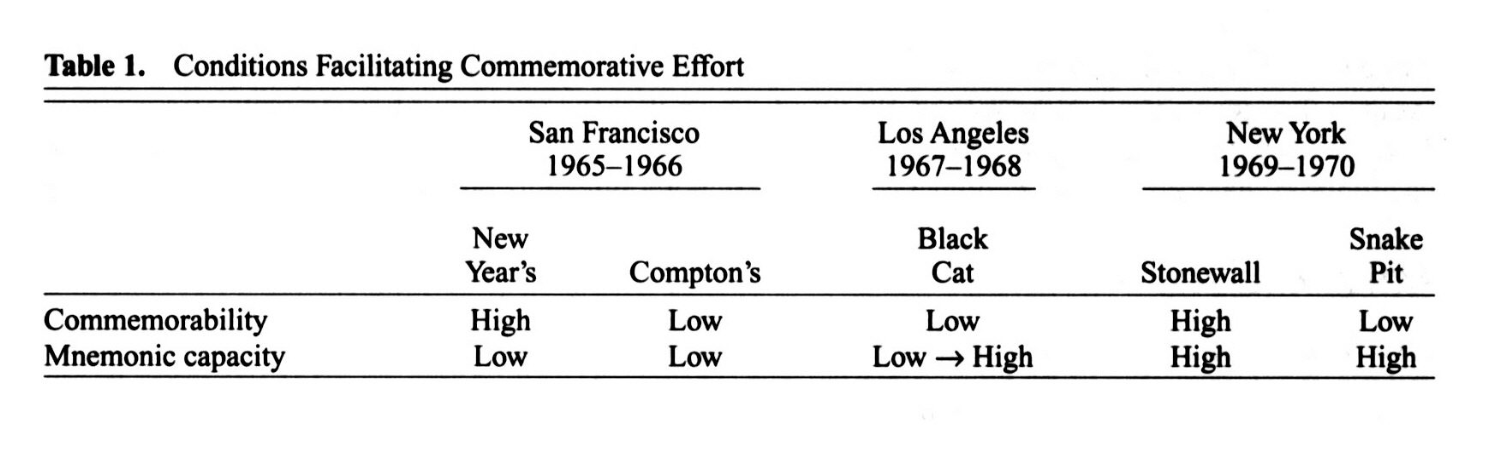
Figure 1. Figure 1 suggests San Francisco activists view this raid as highly memorable.36
However, California Hall’s high commemorability did not produce the same lasting commemorative effects that later followed Stonewall. Though California Hall was dramatic and had even local sympathy, Stonewall had the networks and historical moment to convert its drama into a durable public memory. San Francisco activists could not commemorate the event on even a small, local level. This was due to the lack of knowledge that such an event could be commemorated, nor was there a model to follow and guide on how to do so, despite having sufficient organizational capacity.37 California Hall shows that a dramatic and even self-consciously historic confrontation did not automatically become a national turning point.
Additionally, San Francisco’s relatively liberal political culture also enabled homosexuals’ greater political access and less routine opposition to their expression of sexuality, considering they could even inform the officers of their event and not be raided before the event. Becker and Horowitz described San Francisco as a city with a “culture of civility” with an “accommodation” between police and “deviants.”38 This culture was something other cities at that time did not have, never gave San Francisco the urgency to approach an issue that was not solved on a national level, also defining the difference between the Ball Raid and Stonewall. Even with the civil rights movement at its peak in the South, which brought many influences on freedom movements, San Francisco’s homophile activists could not recognize the radicalizing influences that could have helped their success in commemorating on the national level.39 Their moderate approach produced meaningful but limited success because they treated the raid mainly as a local conflict with the police. This limited their opportunity to create a broader, higher mnemonic capacity - a facilitation that can directly engage with the development of gay commemoration later seen in Stonewall, which relied on this aspect, enabling it to be the turning point of gay commemoration.40 As can be seen in Figure 1, mnemonic capacity is ranked low for New Year’s, whilst high for Stonewall.
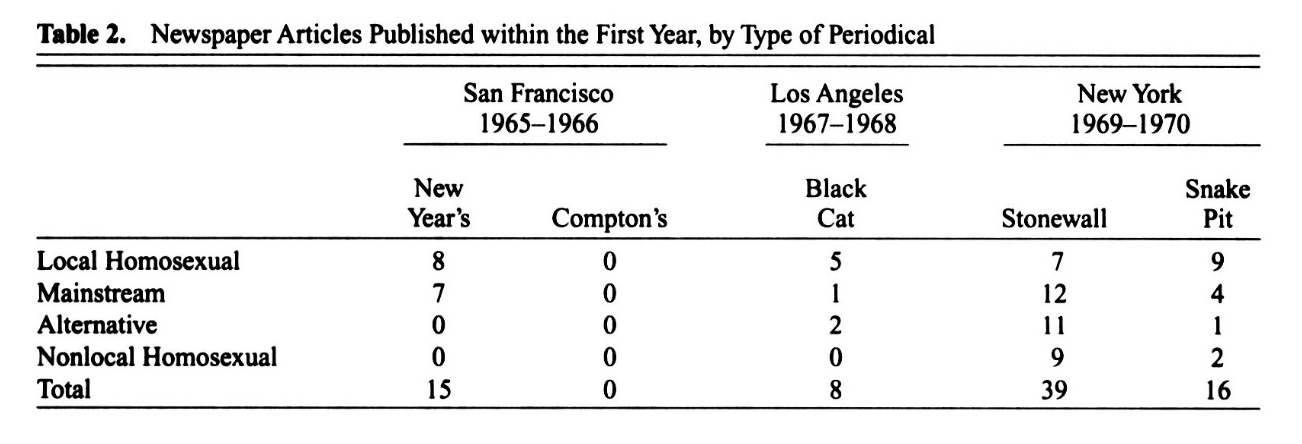
Figure 2. Figure 2 suggests strong coverage in periodicals in the local homosexual periodicals and mainstream press, but none for the nonlocal homophile/nation coverage. Stonewall stands with a similar local homosexual and mainstream coverage, but 9 times more national coverage.41
Thus, with the low mnemonic capacity of the homophile coverage in San Francisco and the rest of the nation, 1965 marked a time D’Emilio describes as a “situation too unique” where “gay men and lesbians in the rest of the country were still too isolated and invisible, for [an event there] to have anything more than a local effect.”42 Though later brought about in published memoirs and descriptions in movement activities by activists, survival in the historical record could not achieve the same as a public commemoration.43 California Hall proves that resistance alone did not guarantee historical significance; what mattered was whether activists could convert that resistance into a durable public memory. Though California Hall mattered, its significance largely remained regional rather than becoming a national symbol. The relatively low exposure further contributed to the misconception of Stonewall being the origin of gay liberation, as California Hall has been forgotten or never seen by anyone else other than historians of sexuality and some homophilic groups in San Francisco.44
The gay movement of Stonewall was indeed different from the movement in San Francisco in 1965. By 1969, unlike 1965, it was a time of many more protest activities, and each became progressively more militant than the last. The country experienced an atmosphere of anti-war protests, riots in Detroit and Newark, and the Civil Rights movement. The overall protest atmosphere created encouragement for New York gay activists and prompted the founding of a radical group in Greenwich Village in early 1969.45 Their meetings included writing periodicals that discussed gains in “gay power.”46 This new gay liberation activity branched off from the simultaneous protests of the civil rights, black power, women’s rights, and New Left movements.47 So, by the spring of 1969, similar forms of gay liberation activism had begun to appear in San Francisco, influenced by activists in New York City and the growing movement that would later culminate in the Stonewall riots.48
Gay liberation movements were also specifically prevalent in New York, not just because of its history in the homophile movement, but also because of the political culture. Different from San Francisco, which had a political atmosphere driven by a liberal climate, New York’s movement was a radical response to a chaotic political environment. On one side, New York was able to challenge police abuse of entrapment and to force the New York Liquor Authority to acknowledge that liquor licenses are not revoked because of one’s sexuality.49 50 However, the political environment remained inconsistent at the same time. In 1966, the mayor initiated a crackdown in homosexual bars in Times Square and Greenwich Village.51 That instability mattered because New York’s less settled political environment made Stonewall feel like part of a larger, unresolved conflict rather than a contained, local dispute like its preceding movements.
To radicalize the movement that would become Stonewall, activists began to adopt public protest as a strategy, an unprecedented, bold growth in the movement. The East Coast Homophile Organizations (ECHO) organized a series of unprecedented public pickets that started the idea of publicity and rituals to commemorate homosexual events.52 53 Activist Craig Rodwell, after one of the early pickets, questioned the success of fulfilling the promise of freedom and equality: “We can call it the Annual Reminder – the Reminder that a group of Americans still don’t have their basic rights to life, liberty, and the pursuit of happiness.”54 This reminder, during an annual July 4th demonstration in front of Philadelphia’s Independence Hall, was sponsored by the Mattachine Societies of New York, Washington, and Philadelphia, and organized by Frank Kameny, taking place in July 1965.55 This event, with 44 participants wearing conservative clothing and carrying cautious protest signs, was held each year in July through 1969.56 This East Coast experience, undoubtedly, provided a model for Stonewall and cast a distinction between the cautiousness or downplay of many other similar protests.
At the same time, New York’s movement radicalized during this period, receiving substantial media exposure and mainstream press coverage.57 With the efforts of activists combined, these homophile activities before Stonewall were covered in the New York Times, New York Post, Village Voice, and Harper’s.58 With the national exposure and distribution of these periodicals, the movements soon gained access to this significant form of protest that helped them hold a distinction compared to the previous gay movements at that time, giving Stonewall an unprecedented advantage over other movements prior.59 Media visibility, however, did not simply publicize activism; it gave Stonewall the means to travel beyond New York and enter national memory.
The Stonewall Inn was a busy place, but it was low on facilities and had no liquor license, often including groups of customers of homeless teens, drag queens, and others who were discriminated against elsewhere, which often attracted monthly raids.60 On June 28th, past midnight, police raided and planned to seize illegal liquor, making arrests – all normalized actions. Though the bar was raided once a month, this time marked an unusual one, where passersby gathered outside instead of escaping.61 62 The growing crowd intimidated the police as they grew angry and started throwing pennies, bricks, and bottles, given that such phenomena had never occurred.63 The police were underprepared for such a scene and soon barricaded themselves within the bar.64 The attacks soon escalated, attempting to trap the police inside the bar.65 Back up arrived soon, and the riot police made an exhausting attempt to disperse the crowd. They tried for hours to disperse the rioters on the street and relieve traffic in the narrow one-way street in front of the bar.66 Only at 3:30 am, when the streets started to finally clear, was the traffic relieved, and taunting ended.67 Soon, papers had come out reporting nearly a thousand rioters, 13 of them arrested, and hundreds of police, 4 of them hurt.68 By gathering on the street outside the bar, people were able to outrun the “worn-out” story. They felt motivated to gather and safe to do so because of the time and location, the heart of Greenwich Village, the center of New York City’s homophile life.69
The success of Stonewall led activists to believe in the political possibilities of gay liberation. Craig Rodwell, a witness to the riot, was on his way home when he “saw the crowd gathered in front of the Stonewall Inn.”70 He discusses his witnessing of Stonewall Inn, which gave him an urge to stay because of a feeling that “something was about to happen.”71 A radical John O’Brien had claimed to run across the escalating riot during “his usual Friday night recreation of debating politics while cruising.”72 The escalation and the attention this event received were dramatically marked by a difference because activists began to construct the significance of the event.73 Extensive coverage was received when activists like Rodwell called for the daily papers.74 Though treatment was generally homophobic, coverage was unprecedented, and it drove attention to the ruined bar itself.75 What distinguished Stonewall, then, was not that it contained unprecedented police raids, but that this particular raid produced a headline ready to be reported and later ritualized.
The building audience soon provided Rodwell and other gay organizations with an opportunity to distribute flyers with messages of gay liberation, a place to shout slogans, and, by the second night of rioting, a reported crowd of nearly 2000 people.76Activists rioted to extend territorial claims in Greenwich, in which they blocked passersby on Christopher Street – Stonewall Inn’s street – and shouted slogans like “Christopher Street belongs to the queens!”77 78 The growing crowd thus converted the riot from a bar raid into a collective public performance of liberation, making it easier to remember in national memory. Unlike California Hall, where the confrontation remained tied to a single event space, Stonewall spilled into the street and showed resistance in the public space, which actively framed Stonewall as a historic turning point compared to other gay rights movements, showing how memory-making began to finally spread publicly.
On Sunday morning June 28, 1969, Rodwell was able to coordinate the distribution of thousands flyers that read “The nights of Friday, June 27, 1969 and Saturday, June 28, 1969 will go down in history as the first time that thousands of Homosexual men and women went out into the streets to protest the intolerable situation which has existed in New York City for many years.”79 80 Rodwell’s brave claims arose out of the feeling of participating in a historical moment, and many who were reported in retrospect and present had shared the same feeling.81 This matters because activists were not merely witnessing history but also attempted to narrate Stonewall as history while it was still going on. Further, these claims were plausible and reliable given the time and provided strong evidence for the dramatic growth of the subject. Soon, these bold assertions created a lasting, unprecedented effect of gay commemoration. That is why Stonewall became the turning point: it was the first dramatic confrontation to occur in a setting where activists could immediately interpret, publicize, and preserve its meaning. As Figure 1 shows, activists saw Stonewall as highly commemorable, and the outcomes of Stonewall marked the turning point in gay history as it became the first dramatic event to occur in a context with a well-developed notion of gay commemoration.
Stonewall deserves its central place in the history of gay liberation, but no because it was the movement’s literal beginning. Earlier confrontations, such as the California Hall raid, show that resistance to anti-gay policing already existed and could even produce local victories. What distinguished Stonewall was the historical setting of late-1960s New York, which offered a militant protest culture, national media visibility, activist networks, and developing forms of public commemoration that allowed organizers to frame the riot as history while it was still occurring. In that sense, Stonewall became a turning point not simply because it happened, but because activists transformed it into an enduring public memory during the riots and afterward. Seeing Stonewall this way corrects the myth of origin without diminishing its importance; instead, it reveals how social movements are shaped not only by protest itself, but also by the stories, rituals, and commemorations that determine which events later generations remember. (4399)
Notes
Armstrong, Elizabeth A. and Suzanna M. Crage, "Movements and Memory: The Making of the
Stonewall Myth, (American Sociological Review 71, no. 5 (2006)). 724-751.
Back to textArmstrong, Crage. “Movements and Memory” 724-725.
Back to textD’Emilio, John. The World Turned: Essays on Gay History, Politics, and Culture (Durham, NC: Duke
University Press, 2002).
Back to textStein, Marc. City of Sisterly and Brotherly Loves: Lesbian and Gay Philadelphia, 1945-1972 (Chicago,
IL: University of Chicago Press, 2000).
Back to textDunlap, David W. “Stonewall, Gay Bar That Made History, Is Made a Landmark.” (New York Times, June
26, 1999) 1.
Back to textDunlap. “Stonewall, Gay Bar That” 1.
Back to textArmstrong, Crage. “Movements and Memory” 725.
Back to textArmstrong, Crage. “Movements and Memory” 725.
Back to textArmstrong, Crage. “Movements and Memory” 725.
Back to textArmstrong, Crage. “Movements and Memory” 725.
Back to textArmstrong, Crage. “Movements and Memory” 725.
Back to textArmstrong, Crage. “Movements and Memory” 728.
Back to textSewell, William H. Jr. Historical Events as Transformations of Structures: Inventing Revolution at the Bastille (Theory and Society 25, 1996) 841-81.
Back to textArmstrong, Crage. “Movements and Memory” 728.
Back to textBelmonte. “Stonewall Riots” 973-974.
Back to textBelmonte. “Stonewall Riots” 973-974.
Back to textArmstrong, Crage. “Movements and Memory” 728.
Back to textKennedy, Elizabeth Lapovsky and Madeline D. Davis. Boots of Leather, Slippers of Gold: The History
of a Lesbian Community (Routledge, 1993).
Back to textLoughery, John. The Other Side of Silence”
Back to textStanley, Bob. 1970. “Gay Pride Week, 1970: That was the Week That was”
(Mattachine Midwest Newsletter, July), 1.
Back to textArmstrong and Crage. “Movements and Memory” 728
Back to textBelmonte. “Stonewall Riots” 973-974
Back to textFussell. “How Stonewall Reversed a”
Back to textArmstrong and Crage. “Movements and Memory” 728
Back to textBoyd, Nan Alamilla. Wide Open Town: A History of Queer San Francisco to 1965.
(Berkeley, CA: University of California Press, 2003).
Back to textArmstrong and Crage. “Movements and Memory” 730
Back to text“After The Ball was Over: What Really Happened.” 1965. (Mattachine Review, January). 8-9.
Back to textD’Emilio, John. Sexual Politics, Sexual Communities. 194.
Back to textD’Emilio, John, 1983. Sexual Politics, Sexual Communities. 194.
Back to textMarcus, Eric. 1992. Making History: The Struggle for Gay and Lesbian Equal Rights, 1945-1990.
(New York: HarperCollins).
Back to textMarcus, Eric. Making History: The Struggle. 141.
Back to text“Private Benefit Ball Invaded,” Vector, January 1965, 1
Back to text“Private Benefit Ball Invaded,” Vector, January 1965, 1.
Back to textD’Emilio, John. Sexual Politics, Sexual Communities, 1983. 194.
Back to textD’Emilio, John, Sexual Politics, Sexual Communities, 1983. 202.
Back to textData from Armstrong and Crage. “Movements and Memory” 729.
Back to textArmstrong and Crage. “Movements and Memory” 730.
Back to textBecker, Howard S. and Irving Louis Horowitz. 1971. “The Culture of Civility.”
4-19 in Culture and Civility in San Francisco, edited by Howard S. Becker. Chicago, IL: Aldine.
Back to textMcAdam, Doug, John D. McCarthy, and Mayer N. Zald.
Political Process and the Development of Black Insurgency, (Chicago, IL: University of Chicago Press, 1930-1970).
Back to textArmstrong, Crage. “Movements and Memory” 730.
Back to textData from Armstrong, Crage. “Movements and Memory” 732.
Back to textD’Emilio, John. 1992b. “Gay Politics, Gay Community; San Francisco’s Experience.” in Making
Trouble: Essays on Gay History, Politics, and the University, edited by John D’Emilio. (New York; Routledge). 74-95.
Back to textArmstrong and Crage. “Movements and Memory” 732.
Back to textArmstrong and Crage. “Movements and Memory” 732.
Back to textCarter, David. Stonewall: The Riots that” 111.
Back to textRodwell, Craig. 1968. “Gay Power Gains.” Hymnal, August-September.
Back to textKissack, Terence. Freaking Fag Revolutionaries: New York's Gay Liberation Front, 1969-71
(Radical History Review 1995), 62. 104-34.
Back to textStryker, Susan and Jim Van Buskirk. “Gay by the Bay”
Back to textKinsey Institute Library, Indiana University, Bloomington. Folder on Homosexual Organizations: Mattachine Society, Inc., New York. N.d. The Homosexual Revolution.
Back to textCarter, David. Stonewall: The Riots that” 115.
Back to textAlwood, Edward. 1996. Straight News: Gays, Lesbians, and the News Media. New York: Columbia University Press.
Back to textMarotta, Toby. The Politics of Homosexuality. Boston, MA: Houghton Mifflin. 1981.
Back to textD’Emilio, John, Sexual Politics, Sexual Communities.
Back to textDuberman, Martin. “The Making of a Myth.” 113.
Back to textKameny, Frank. 1965. “Homosexuals Picket in Washington and Philadelphia.” Eastern Mattachine Magazine, September, 19-21.
Back to textKameny, Frank. “Homosexuals Picket in Washington.” 19-21.
Back to textArmstrong and Crage. “Movements and Memory” 735.
Back to textMarotta, Toby. The Politics of Homosexuality. 27.
Back to textArmstrong and Crage. “Movements and Memory” 735.
Back to textLeitsch, Dick. 1969a. “Police Raid on NY Club Sets off First Gay Riot.” (Advocate, September). 3.
Back to textCarter, David. Stonewall: The Riots that” 143.
Back to textDuberman, Martin. “The Making of a Myth.” 113.
Back to textCarter, David. Stonewall: The Riots that” 147.
Back to textDuberman, Martin B. 2004. Stonewall. New York:Plume. 2004. “The Making of a Myth.”
Gay & Lesbian Review Worldwide 11. 22.
Back to textCarter, David. Stonewall: The Riots that” 168.
Back to textCarter, David. Stonewall: The Riots that” 176.
Back to text4 Policemen Hurt in ‘Village’ Raid: Melee Near Sheridan Square Follows Action at Bar.
(New York Times, June 29, 1969), 33.
Back to text“4 Policemen Hurt in ‘Village’ Raid” (New York Times), 33.
Back to textArmstrong and Crage. “Movements and Memory” 737.
Back to textCarter, David. Stonewall: The Riots that” 164.
Back to textCarter, David. Stonewall: The Riots that” 167.
Back to textCarter, David. Stonewall: The Riots that” 164.
Back to textArmstrong and Crage. “Movements and Memory” 737.
Back to textArmstrong and Crage. “Movements and Memory” 737.
Back to textAlwood, Edward. Straight News: Gays, Lesbians” 85.
Back to textClark, Lige, and Jack Nichols. NY Gays: Will the Spark Die? (Advocate, September 1969), 3.
Back to textLeitsch, Dick. 1969b. “The Hairpin Drop Heard Around the World.” (New York Mattachine
Newsletter, July), 21-23.
Back to textCarter, David. Stonewall: The Riots that. 186.
Back to textClark, Lige, and Jack Nichols. NY Gays: Will the. 3.
Back to textTeal, Donn. The Gay Militants: How. 8.
Back to textCarter, David. Stonewall: The Riots that. 196.
Back to text
Bibliography
“4 Policemen Hurt in ‘Village’ Raid: Melee Near Sheridan Square Follows Action at Bar.” New York Times, June 29, 1969, 33.
“‘After the Ball Was Over’: What Really Happened.” Mattachine Review, January/February 1965, 8–9.
Alwood, Edward. Straight News: Gays, Lesbians, and the News Media. New York: Columbia University Press, 1996.
Armstrong, Elizabeth A., and Suzanna M. Crage. “Movements and Memory: The Making of the Stonewall Myth.” American Sociological Review 71, no. 5 (2006): 724–51.
Becker, Howard S., and Irving Louis Horowitz. “The Culture of Civility.” In Culture and Civility in San Francisco, edited by Howard S. Becker, 4–19. Chicago: Aldine, 1971.
Belmonte, Laura. “Stonewall Riots.” In America in the World, 1776 to the Present: A Supplement to the Dictionary of American History, edited by Edward J. Blum, 2:973–74. Farmington Hills, MI: Charles Scribner’s Sons, 2016. Gale In Context: U.S. History. Accessed April 19, 2026.
Boyd, Nan Alamilla. Wide-Open Town: A History of Queer San Francisco to 1965. Berkeley: University of California Press, 2003.
Carter, David. Stonewall: The Riots that Sparked the Gay Revolution. New York: St. Martin’s Press, 2004.
Clark, Lige, and Jack Nichols. “NY Gays: Will the Spark Die?” The Advocate, September 1969, 3, 12.
D’Emilio, John. “Gay Politics, Gay Community: San Francisco’s Experience.” In Making Trouble: Essays on Gay History, Politics, and the University, 74–95. New York: Routledge, 1992.
D’Emilio, John. Sexual Politics, Sexual Communities: The Making of a Homosexual Minority in the United States, 1940–1970. Chicago: University of Chicago Press, 1983.
D’Emilio, John. The World Turned: Essays on Gay History, Politics, and Culture. Durham, NC: Duke University Press, 2002.
Duberman, Martin B. Stonewall. New York: Plume, 1993.
Duberman, Martin B. “The Making of a Myth.” Gay & Lesbian Review Worldwide 11, no. 1 (January/February 2004): 22.
Dunlap, David W. “Stonewall, Gay Bar That Made History, Is Made a Landmark.” New York Times, June 26, 1999, 1.
Fussell, Sidney. “How Stonewall Reversed a Long History of Justifying Police Surveillance.” The Atlantic, June 29, 2019.
Kameny, Frank. “Homosexuals Picket in Washington and Philadelphia.” Eastern Mattachine Magazine, September/October 1965, 19–21.
Kennedy, Elizabeth Lapovsky, and Madeline D. Davis. Boots of Leather, Slippers of Gold: The History of a Lesbian Community. New York: Routledge, 1993.
Kinsey Institute Library, Indiana University, Bloomington. “The Homosexual Revolution.” Folder on Homosexual Organizations: Mattachine Society, Inc., New York. N.d.
Kissack, Terence. “Freaking Fag Revolutionaries: New York’s Gay Liberation Front, 1969–71.” Radical History Review, no. 62 (1995): 104–34.
Leitsch, Dick. “Police Raid on N.Y. Club Sets Off First Gay Riot.” The Advocate, September 1969, 3, 11–12.
Leitsch, Dick. “The Hairpin Drop Heard Around the World.” Mattachine Society of New York Newsletter, July 1969, 21–23.
Leitsch, Dick. “The Stonewall Riots: The Gay View.” Mattachine Society of New York Newsletter, August 1969, 13–14.
Loughery, John. The Other Side of Silence: Men’s Lives and Gay Identities: A Twentieth-Century History. New York: Henry Holt, 1998.
Marcus, Eric. Making History: The Struggle for Gay and Lesbian Equal Rights, 1945–1990: An Oral History. New York: HarperCollins, 1992.
Marotta, Toby. The Politics of Homosexuality. Boston: Houghton Mifflin, 1981.
McAdam, Doug, John D. McCarthy, and Mayer N. Zald. Political Process and the Development of Black Insurgency, 1930–1970. Chicago: University of Chicago Press, 1982.
“Private Benefit Ball Invaded.” Vector, January 1965, 1.
Rodwell, Craig. “Gay Power Gains.” Hymnal, August–September 1968.
Sewell, William H., Jr. “Historical Events as Transformations of Structures: Inventing Revolution at the Bastille.” Theory and Society 25 (1996): 841–81.
Stanley, Bob. “Gay Pride Week, 1970: That Was the Week That Was.” Mattachine Midwest Newsletter, July 1970, 1.
Stein, Marc. City of Sisterly and Brotherly Loves: Lesbian and Gay Philadelphia, 1945–1972. Chicago: University of Chicago Press, 2000.
Stryker, Susan, and Jim Van Buskirk. Gay by the Bay: A History of Queer Culture in the San Francisco Bay Area. San Francisco: Chronicle Books, 1996.
Teal, Donn. The Gay Militants: How Gay Liberation Began in America, 1969–1971. New York: St. Martin’s Press, 1995.