Poetry
white lies tomorrow (Ekphrasis on Time 100 Image)
Read the author’s reflection ↓
my eyes through the undersides of
red shelves,
yellow cord loops my boot,
around my neck coils flesh
my wrist much the same.
Son, there are things
I meant to tell you sitting down,
at the kitchen table I studied law,
taught you to look people in the eye,
corrected your English
until when I spoke mother’s tongue,
you’ll answer in another. we changed tires,
the nuts inside the hubcap,
time around our wrists enough
to get down on our knees
and beneath.
the Windsor took longer, behind you
I stood at the mirror so you could
follow my hands, slipping
a finger beneath your collar
to leave you room.
here, my mouth is open,
the photograph will keep it that way.
When I do not come home tomorrow,
know how to knot the tie,
one of the many less tangible I regret
never teaching you is
how to
without me.
Author’s reflection
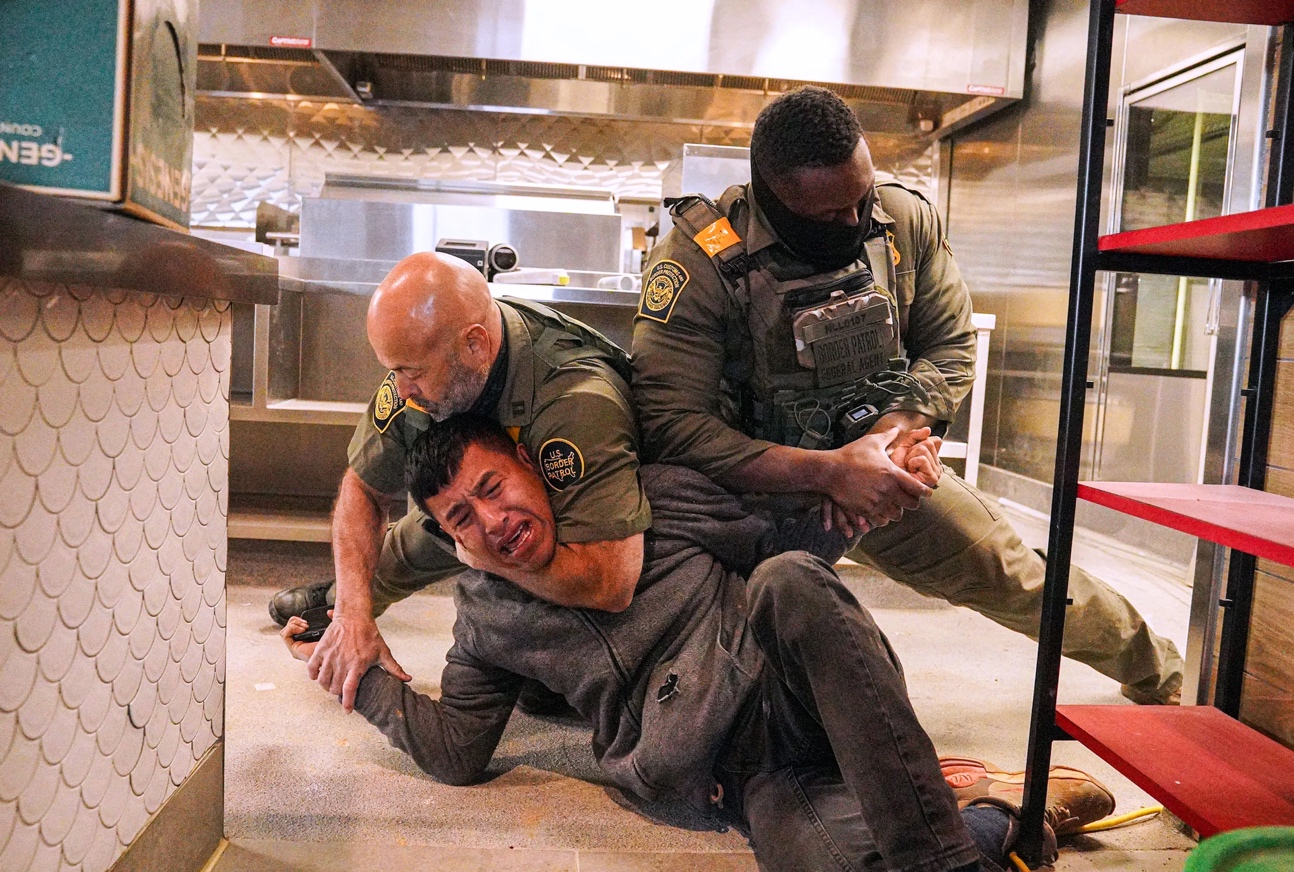
I kept returning to the ordinary things in Ryan Murphy’s photograph: the kitchen behind the man and the red shelves above him. I learned that the setting was a Panda Express, a place I could easily pass or eat in myself. That familiarity made the scene more frightening. I noticed the hands holding his neck and wrist, but what stayed with me was his open mouth. What was he trying to say? Was anyone listening?
My responses kept coming back to the people outside the frame, especially whoever might be waiting for him to come home. I felt frightened for him in a way that reminded me of Eunice and her husband in I’m Still Here. The photograph does not tell me whether this man is a father. For the poem, I imagined one, suddenly unable to promise his son that he would return.
I wanted to think about what a father might teach his child to keep him safe in a country where he does not always feel safe himself. He corrects his son’s English until the son answers in a language different from his own. I imagined the care behind that choice, but also what it costs him. Changing a tire and tying a Windsor knot became ways for him to prepare his son for a future he might not be there to see. At the mirror, his hand leaves room beneath the collar; in the photograph, another hand closes around his neck.
The photograph holds his mouth open, but it cannot let us hear him. I wanted the poem to spend time with that silence and with the life that might continue beyond it. He has taught his son how to do ordinary things. What he has not found a way to teach is how to live without him. The unfinished “how to” leaves that lesson unfinished, too.